Understanding the Sacrament
What is Confession?
The Sacrament of Reconciliation is a sacrament of healing.
It is a moment to:
- • Heal the soul
- • Restore the heart
- • Correct what is not working in our lives
Confession is not about guilt; it is about restoration and mercy.
The Purpose
Why go to Confession?
Forgiveness is not something we can give ourselves. It must be asked for and received from another.
In confession:
- • We ask Jesus for forgiveness
- • Forgiveness is a gift, not something we earn
- • It comes through the Holy Spirit
Confession is an encounter with grace, not effort.
The Process
The 4 Steps of a Good Confession
These steps lead us to receive God’s embrace of mercy.
Step 1
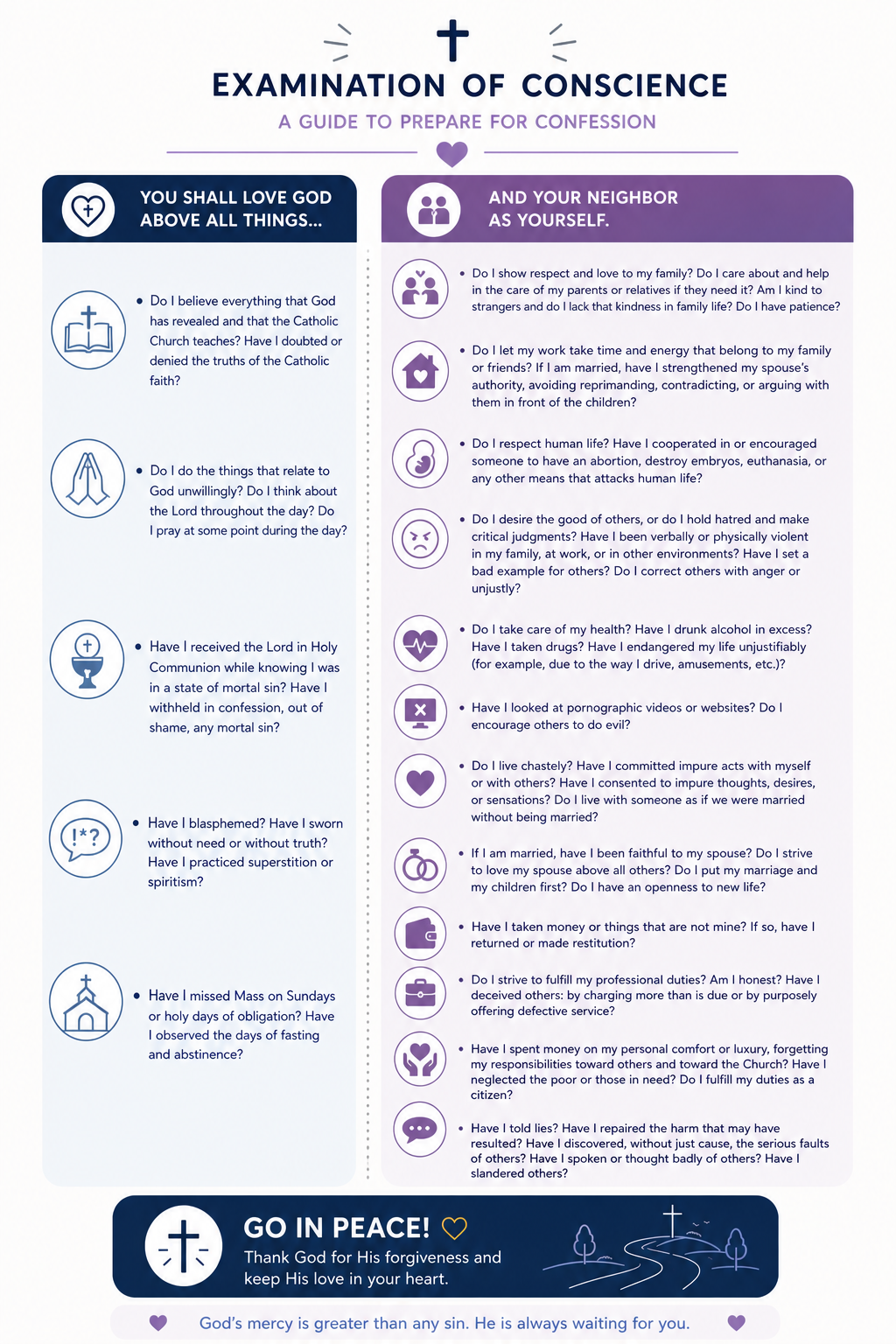
Examination of Conscience
Reflect on:
- • Actions
- • Thoughts
- • Words
Ask yourself:
- • What has distanced me from God?
- • Have I hurt others?
- • Have I harmed myself spiritually?
Key attitude:
- • Be honest and sincere
- • Open your heart without fear
The "4 C's" of a good confession:
- Clear → Name the specific sin
- Concrete → Avoid vague language
- Concise → No unnecessary explanations
- Complete → Do not hide serious sins
Step 2
Contrition (Repentance)
True contrition means:
- • Sorrow for sins
- • Rejection of wrongdoing
- • Desire to change
Includes:
A firm purpose not to sin again.
Important to remember:
- • It is a gift from God
- • Feelings (such as guilt or shame) are not required
What matters is:
- • Understanding the wrong
- • Wanting to improve
Ask God for help if change feels difficult.
Step 3
Confessing Sins
Confession means:
Speaking your sins to a priest.
Why a priest?
He represents Jesus.
It makes forgiveness:
- • Real
- • Concrete
- • Personal
Remember the 4 C’s:
- • Clear
- • Concrete
- • Concise
- • Complete
This is an act of humility and trust.
Step 4
Doing the Penance
Penance is:
A small act given by the priest.
Usually:
- • Prayers
- • Acts of sacrifice
- • Acts of repair
Purpose:
- • Repair the damage caused by sin
- • Strengthen your commitment to change
It is also a moment to give thanks to God.